The word "FDE" gets tossed around a lot these days.
My hot take is that most companies hiring for FDEs aren't actually hiring FDEs. Unless you are traveling to the customer site because the complexity of the deployment requires it, you are just a glorified solutions engineer.
I know this because I've done a lot of work as a fake FDE. But this past week, I actually embedded myself into one of my client companies Bednark.
The difference is night and day.
The background
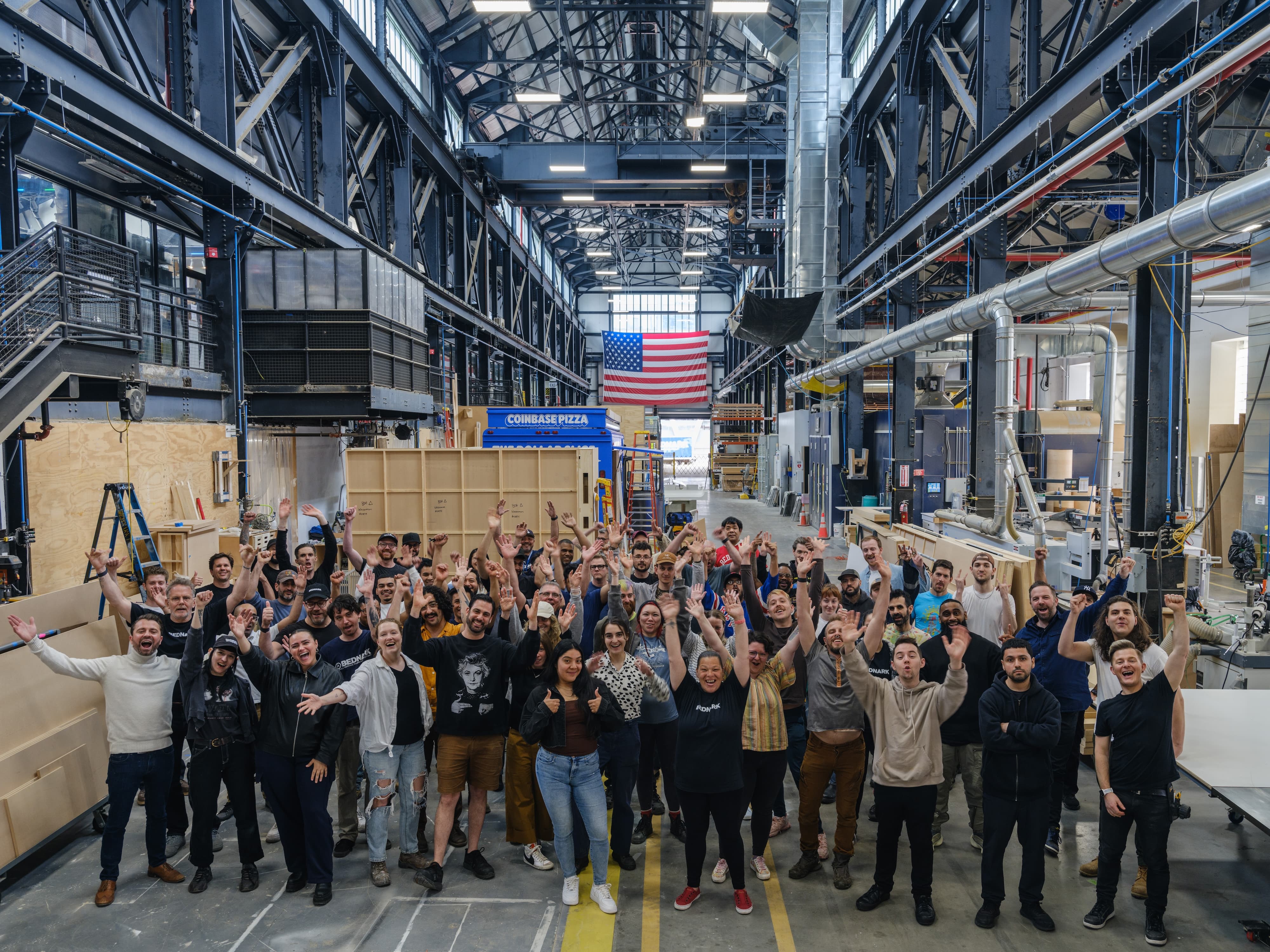
Founded in 2007, Bednark is a fabrication job shop based in the Brooklyn Navy Yard. If you're walking around Fifth Avenue and you see a crazy retail pop-up, chances are Bednark built it.
The company has over 100 employees and does over 8 figures in annual revenue across experiential marketing and architectural millwork. They worked with some of the biggest brands in the world, and are pretty much best in class for what they do.
In June, Bednark's CEO Raphael attended a wedding in South Africa. Apparently he wouldn't stop talking about AI on the safari, and coincidentally one of my friends Westley was there as well. He introduced me to him to hop on a 30 min call to see if I can offer my perspectives, and by the end of that call I was drafting a SOW.
In the early days of working together, I mainly worked with Bednark's business development team. My mandate was simple – roll out Claude to the fullest extent with this team.
What this meant was developing skills and custom MCPs to systems of record that Claude couldn't talk to yet. And about once every 2 weeks, I'd host workshops to teach people how to build their own Claude artifacts.
My philosophy for phase 1 of successful AI rollout is to treat everyone like a builder.
It first clicked for me listening to this Boris Cerny interview. When you listen to his story, it's clear that one of the themes in his career that led to ideas for Claude Code was working deeply in DevOps and building infra to unlock engineers on his team.
If AI makes everyone a builder, then a similar role needs to exist at every company.
Scoping up
That first phase went pretty well. Before we knew it, power users started to emerge that were having over 300+ Cowork sessions a week.
We then expanded our scope to start working with the project management office (PMO) as well the production department which includes drafting, carpentry, CNC, finishing, etc.
But as I got closer to the shop where all the actual work was happening, I found it harder and harder to run productive discovery sessions. I got the sense that there would always be a gap in the information we could absorb through Google Meets.
After that realization, I convinced Raph to fly me and Izu out for a week in November to be more aggressive on some goals we had set by EOY.
Onsite
For more context, the EOY goal was for the company to start using 2 products that Izu and I were building out:
- Client portal. A customer-facing portal for Bednark clients that they can use to check in on timelines, approvals needed, and contract details.
- Handoff Hub. An internal tool for managing BD to PM handoffs and collating disparate information today living in emails, meeting transcripts, Google Drive, etc.
We were doing weekly reviews with the team, but the theory is that this would all happen much faster if we were in person.
Setup
Here's how we structured the weeks leading up to the onsite across both projects:
- [T-3 weeks] Feedback round #1
- [T-2 weeks] Feedback round #2
- [T-1 week] Code complete. Both products are fully ready to be used by the team
- [Onsite] 2 goals
- Successfully install client portal and handoff hub. This means that the team is actually using both products day-to-day.
- Learn as much as we can about other problems.
The second goal was intentionally vague. We didn't know what we didn't know, but I had a strong sense that the delta between reality and what we experienced through Google Meets was quite large.
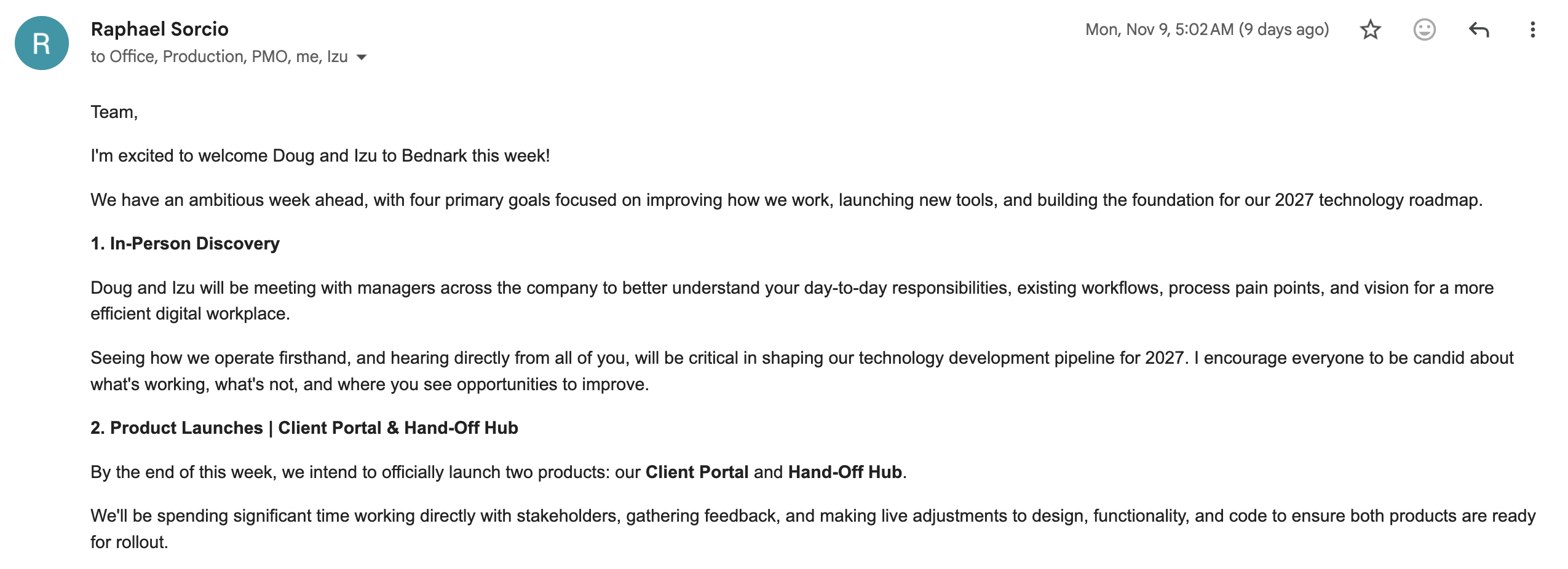
Leading up to the onsite, the 3 of us checked in every week. Raph's job was to make sure the team knew we were coming and could mentally budget time to talk to us. And our job was to make sure they'd have a reason to talk to us.
What everyday looked like
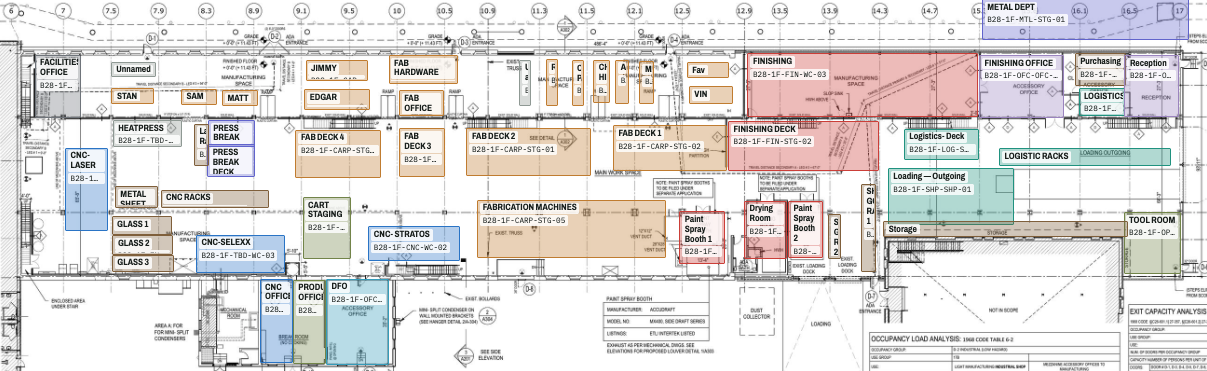
On the first day, we started with a full tour of the building and shop floor. This was very useful. It introduced us to all the key players and helped us orient ourselves in the physical space. Now when someone said "You should go talk to Aidan", I knew exactly where he sat.
We booked the closest hotel so we can walk to the office in 10 mins. And everyday, we hosted a quick 15 min standup at 10am that everyone in the company was invited to. This was incredibly valuable for a few reasons.
- Accountability. Made sure we were on track to deliver on the goals we'd set.
- Cadence. Kept everyone excited and the energy high.
- Introductions. Nothing is more valuable than "You should talk to X. Have you talked to them yet?"
Here's a good example of a workstream that we were able to iterate on extremely quickly.
Problem: Tracking things on the shop floor
On Monday, production manager Aidan reached out to me and scheduled a cross-functional meeting with 5 people to discuss a problem.
It was a contentious meeting with a lot of talking over each over. But from what I gathered there were really 2 problems:
- Shipment item tracking. Today there isn't a very good system for tracking things that are loaded onto the truck in the shop and then unloaded at install. Because of this, everything appears to be missing at install and everyone spends a lot of time chasing these elements.
- Parts tracking. Similar to the above, even before they get assembled into elements the parts are not tracked very well as they move through the shop from CNC to carpentry to finishing. The big problem here is that when individual elements need to be recut, people are once again chasing.
After this meeting, I spent some time poking around the shop drawings and .dxf cut files. The cut files lay out all the parts we need to CNC as a flat 2D sheet. The shop drawings show the person assembling it what the final products would look like in 3D.
In my mind, a first step in solving both problems would be to merge these together so we can start resembling the relationship between parts and their final assembled elements. So built a prototype tool for something like this with Claude:
The next day, I presented this at the standup and gave context to the conversation we had the day before. On top of that, I also shared very candidly the things I felt like I didn't fully understand (ex: why the existing QR code process wasn't getting used).
Then someone said "You should talk to Joe and Kenny from trucking & logistics. They would have some thoughts on how shipment items are tracked."
Immediately after that, I went down to their office. Asked a bunch of questions, got clued into some concrete examples, and then built a tool for planning truck fits.
I presented this again the next day, and it once again led to more conversations. I wrote about to run an effective discovery session, but this was a great learning in how keep building momentum in a workstream and balance rapid prototyping with ongoing discovery.
The results
The week went so well that halfway through the week Raph offered to extend us to stay another week. I couldn't stay for personal reasons, but Izu decided to stay to keep building on the momentum we had.
When I tried to sit down and pinpoint what can capture the success of the week, I came up with the following leading indicators:
- # of times someone defaults to "Claude can help with this". I wish I could measure this across the board, but whether or not folks are reaching for Claude has been the most predictive of usage increase and stickiness.
- General Claude usage. After we left last week, the messages per day increased to 555 (+65.7%) and DAUs increased to 37 (+15.6%).
But the jury is still out.
At the end of the day, what matters is whether AI can improve margin or increase top line for Bednark and it's too early to tell. For now though, if there's anything I can definitely say we did it was changing people's attitudes towards AI.
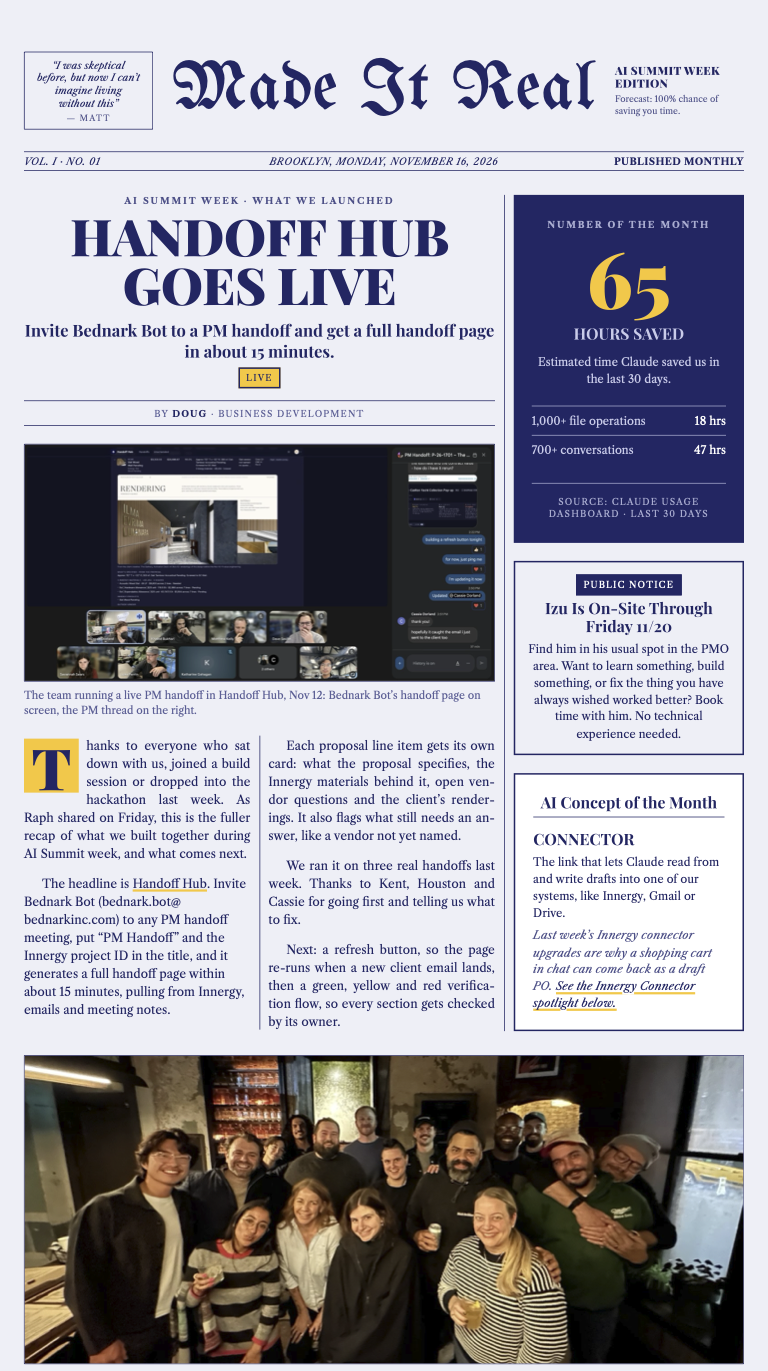
Part of that is showing them what it can do. Part of it is the trust building that comes from visiting people in-person. Here is the company-wide newsletter that I sent out to recap the week:
What I would have done differently
I learned a lot of things during my week there, but here are a few:
-
Build trust early and often. It's all in the small things and how you show up. Go to their desk. Shake their hand. Say "I don't know" sometimes because you don't have all the answers.
-
Schedule your own meetings. If you let them schedule all your meetings, you'll end up joining a lot of big group meetings. The most effective thing is focused 1:1 sessions. Politely decline meetings that aren't helpful and schedule your own.
-
Be honest about what's shippping. It's so easy to spin up a flashy demo, and when you do that you have to be aware that people can't help but think "I can't wait to use this once it's live!" But not every tool is destined for this, and if you don't have intentions on productionizing something, say it. What I often said was that these prototypes were a good way for me to do "visual notetaking" and reflect back to people what I heard. I started doing that halfway through the week, but I should have done it sooner.
Necessary but not sufficient
When I reflect back on what made this week so well, there's a single thing that comes to mind.
Back in June, I was naive. I thought that successful AI adoption in an organization should be purely bottoms-up. That if the tools worked, people would use it. It's almost like the AI version of "If I build it, they will come."
What I've realized though is that you need to drive this from the top-down as well. Having a strong executive champion who is very involved means that you have a direct line to power. A way to quickly turn the dial up to 10 if something that needs to get done is not happening.
After an intense, we were jamming with Raph on the client portal in his office. "Wow, I can't believe this is the first time we've stepped foot into your office all week" I said.
"Good, that means you guys have been talking to the right people."
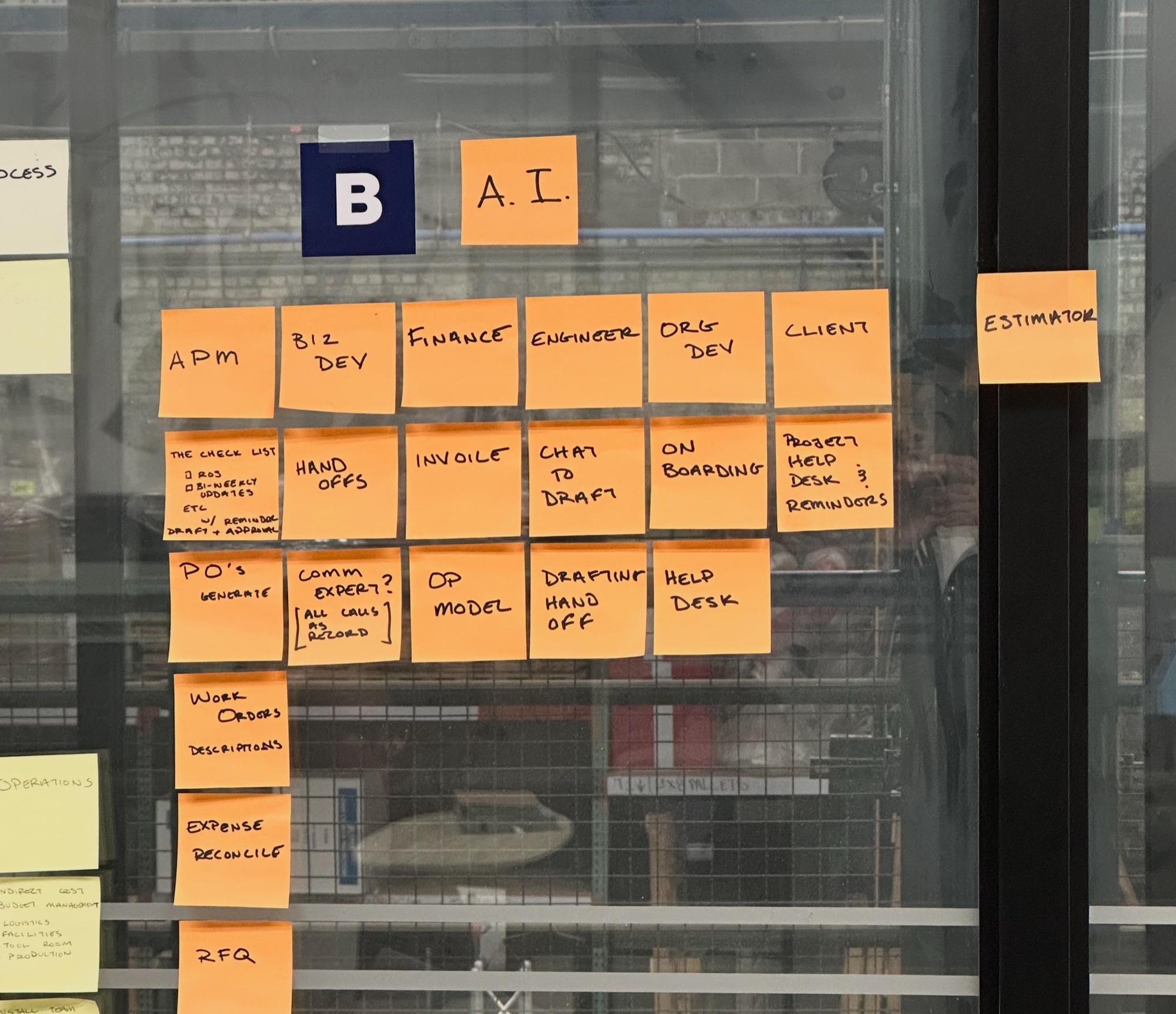
Then when I turned around to leave the office, I reoriented to the same view point as Raph from his desk and I saw this:
Closing thoughts
If there's anything I learned from this week, it's that I love this kind of work. Getting my hands dirty, building relationships, and in-person problem solving.